

Three Phase UPS Systems for Critical Power Environments
In high-demand sectors like data centres, manufacturing, telecom, and education, even a momentary loss of power can mean significant disruption. A three phase UPS system is engineered to deliver uninterrupted, high-capacity backup to support mission-critical infrastructure without compromise.
At Vallous International, we provide a robust portfolio of enterprise three phase UPS solutions for facilities that simply cannot afford downtime. Designed for scalability, redundancy, and seamless integration, our three-phase systems offer a powerful line of defence against power loss, surges, and fluctuations, ensuring operational continuity across Singapore’s most essential industries.
From mid-sized installations to hyperscale deployments, our lineup includes trusted product families such as APC’s Easy UPS 3-Phase Modular, Galaxy V Series, Eaton-93PR-25-200kW UPS, and more, each engineered for efficiency, performance, and future-ready scalability.
Explore Our APC Three Phase UPS Line-up
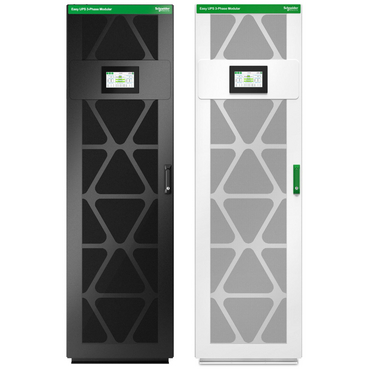
Easy UPS 3‑Phase Modular
Robust, Scalable Power Protection with Lithium-Ion Compatibility
Built for medium to large facilities, the Easy UPS 3‑Phase Modular delivers highly efficient and space-saving power protection. Its modular design ensures redundancy and flexibility, making it ideal for growing operations seeking both cost-effectiveness and scalability.
Key Features:
- 50–250kW 400V range
- Compact footprint with modular scalability
- Supports lithium-ion batteries for longer lifecycle
- Optimised for edge, campus, and regional data centres
- Advanced monitoring with EcoStruxure™ compatibility
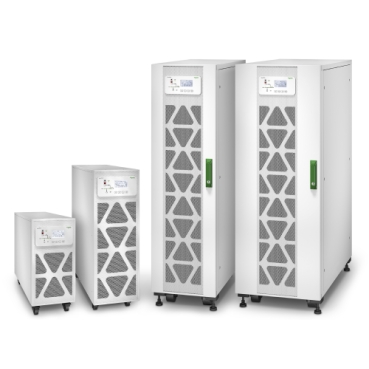
Easy UPS 3‑Phase (Non-Modular)
Reliable Performance for Business-Critical Environments
Tailored for small to medium data centres and commercial sites, this non-modular range offers reliable, double-conversion power protection without the added complexity of modularity.
Key Features:
- Power ratings from 10–200kVA, 400V
- Parallel capability for scalability
- High efficiency with low total cost of ownership
- Integrated LCD touch display for diagnostics
- Ideal for IT, healthcare, and education facilities
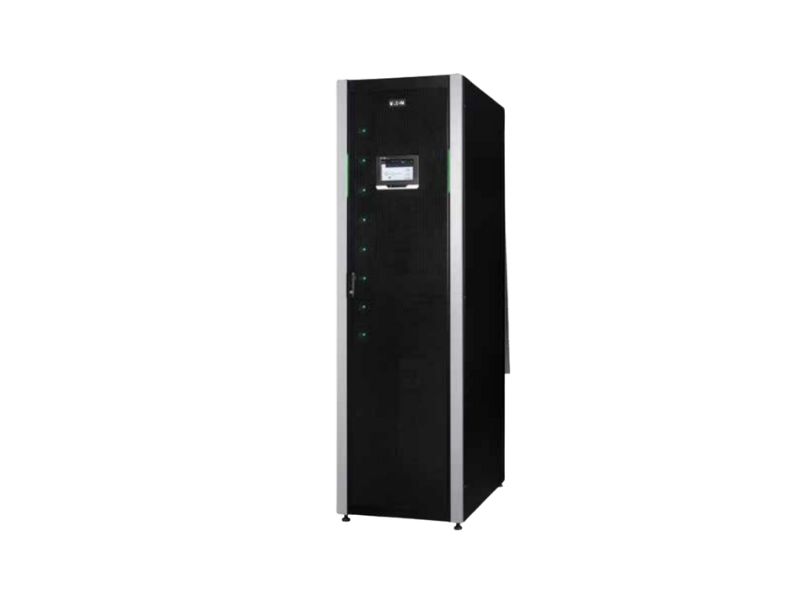
Eaton 93PR UPS 25-200kW
High Efficiency, Small Footprint, Scalable UPS
The Eaton series is trusted for its energy-efficient architecture, compact design, and seamless deployment in high-density settings. Often seen in enterprise three phase UPS environments, Eaton’s systems are designed for modular growth and operational sustainability.
Key Features:
- Power rating (1.0 p.f.) ranges from 25 kW to 200 kW output range
- Unity power factor for full load support, delivering up to 20% more real power than other UPSs in its class
- Modular design allows for easy scaling up (up to 800 kW by paralleling 4 frames) without increasing footprint
- Can reach up to 99% efficiency with the Energy Saver System (ESS) and over 96% in double conversion mode
- Suited for large commercial, data centre, and industrial facilities
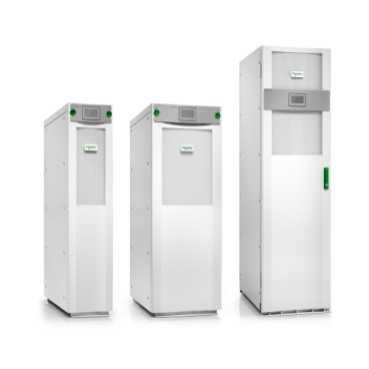
Galaxy V Series UPS
High Density. Low TCO. Future-Ready Power Infrastructure
Engineered for the most demanding environments, Galaxy V Series UPS systems offer a robust platform for hyperscale deployments, with maximum scalability and sustainability built in.
Key Features:
- 10–500kVA capacity
- High efficiency with ECOnversion™ technology
- Flexible battery options including lithium-ion
- Suited for colocation, cloud, and mission-critical IT spaces
- Seamless EcoStruxure™ integration for remote insights
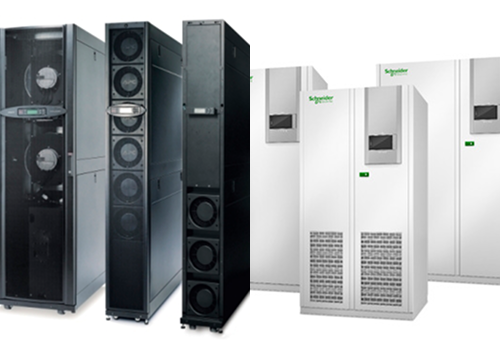
InRow Cooling & Room Cooling Solutions
Thermal Management for UPS Reliability
Power protection is only half the story. Effective cooling is essential to protect your UPS and battery infrastructure. We offer:
- InRow Cooling: Close-coupled systems for targeted cooling in confined, high-density spaces.
- Room Cooling: Perimeter cooling for full-room airflow control, ideal for server rooms and central IT hubs.
Which Three Phase UPS Family Suits Your Requirements?
Choosing the right three phase UPS system depends on your environment’s size, risk tolerance, and future expansion plans. Here’s how our range supports different operational demands:
Easy UPS 3‑Phase Modular
Best suited for mid-sized facilities where space, cost efficiency, and modular redundancy are top priorities.
Eaton 93PR UPS 25-200 kW
Ideal for small to mid-sized data centres and other mission-critical applications where efficiency, reliability, safety and scalability are essential.
Galaxy V Series
Designed for high-density, scalable infrastructure, suitable for cloud providers, colocation data centres, and universities preparing for rapid digital transformation.
For businesses unsure where to start, Vallous offers consultation using tools akin to a UPS size calculator to help assess load requirements, battery runtime expectations, and lifecycle costs.
When choosing your solution, consider:
- Runtime requirements – Will your loads need extended battery support or generator bridging?
- Power factor and load type – Match UPS output characteristics to the equipment being protected.
- Battery technology – Lithium-ion offers longer life and smaller footprint, while lead-acid provides cost-effective deployment.
- Scalability – Modular or parallel-ready designs support long-term growth without rework.
Three Phase UPS Comparison Table
| Model | Power Rating | Output Power Factor | Battery Type | Form Factor | Use Case | Runtime Scalability |
|---|---|---|---|---|---|---|
| Easy UPS 3-Phase Modular | 50–250kW | 1 | Lithium-ion/VRLA | Modular Tower | Medium Data Centres, Healthcare | High |
| Easy UPS 3-Phase | 10–200kVA | 0.9–1.0 | VRLA | Tower | Small Data Centres, Retail | Medium |
| Eaton 93PR UPS 25-200kW | 10–500kVA | 1 | Lithium-ion/VRLA | Rack/Tower | Small to Mid-sized Data Centres | High |
| Galaxy V Series | 10–500kVA | 1 | Lithium-ion/VRLA | Rack/Tower | Hyperscale, Telecom, Universities | High |
FAQs about Three Phase UPS Systems
1. What is a three phase UPS system, and how does it differ from a single-phase UPS?
A three phase UPS delivers power using three alternating currents, each offset by 120 degrees, ensuring a stable and efficient power supply for high-capacity loads. In contrast, a single phase UPS uses one alternating current and is typically used for smaller or individual equipment setups. You can learn more about the differences in our guide to single phase and three phase power.
2. When is a three-phase UPS necessary for my facility?
A three phase UPS is essential for facilities with heavy-duty equipment, data centres, or large industrial systems that require balanced and continuous power distribution. For smaller offices or retail operations, a single-phase UPS may suffice. If you’re unsure, explore our critical power solutions or contact our team for tailored advice.
3. Can three phase UPS systems be installed as modular or expandable systems?
Yes, many three phase UPS systems are designed to be modular. This allows scalability, enabling you to expand capacity as your business grows. Modular UPS configurations are also easier to maintain and minimise downtime. Explore our solutions to find scalable UPS systems that fit your operational needs.
4. How long can a three phase UPS support the load during a power outage?
Backup duration depends on the total load, battery capacity, and efficiency of your UPS. Generally, a three-phase UPS can provide anywhere from a few minutes to several hours of backup power. For mission-critical environments, extended battery modules or generators can be added to increase runtime.
5. What factors affect the battery lifespan in a three phase UPS?
Battery lifespan is influenced by temperature, load levels, charge/discharge cycles, and maintenance frequency. Keeping batteries in a controlled environment and performing regular servicing can help prolong their lifespan.
6. Can three-phase UPS systems use lithium-ion batteries instead of lead-acid?
Yes. Modern three phase UPS systems can integrate lithium-ion batteries, offering higher energy density, faster charging, and longer lifespans compared to traditional lead-acid batteries. They are particularly suited for data centres and high-demand industrial operations where reliability is critical.
7. Which type of UPS delivers greater efficiency and lower distribution losses over long distances?
A three phase UPS provides higher efficiency and reduced power loss during transmission compared to single-phase systems, making it ideal for facilities with high-capacity loads and longer cable runs.
